ReguComply Enterprise Legal & Regulatory Compliance Automation Suite
Enterprise compliance suite spanning three coordinated web applications (Rule Master, Client Management, and Client Dashboard) that streamline legal change requests, multi-tenant onboarding, and regulatory audit tracking.
Frontend Engineer & Technical Contributor
04/2026 - Present
Vidhikarya Legal Services LLP
Full-Stack Web
The Problem & Engineering Constraints
Why this system needed to be built
Enterprise compliance teams previously relied on manual spreadsheets and disconnected tracking to manage fast-moving legal amendments. ReguComply unites regulatory curators, account administrators, and corporate clients into a single synchronized platform.
Corporate compliance officers, legal analysts, enterprise administrators, and compliance task assignees.
Real-World Constraints
Non-Negotiables- Zero-breakage refactoring: Modernize complex 800+ line legacy monoliths into atomic components without disrupting active client compliance records.
- High-density data: Maintain smooth sub-100ms interactions across deeply nested compliance clauses, multi-field filters, and real-time diffs.
- Multi-panel coordination: Align shared domain models and strict access boundaries across three distinct applications.
- Remote team alignment: Balance autonomous frontend architectural choices with asynchronous requirement gathering in a distributed setup.
*Every architecture decision was framed strictly around these constraints.
System Architecture & Key Decisions
High-Level System Architecture
Structured across three domain-focused frontend applications sharing a common design system: Rule Master (legal curation and Change Requests), Client Management (multi-tenant onboarding and system health), and Client Dashboard (compliance monitoring and task delegation).
Architectural Trade-Off Analysis (Micro-ADRs)
Three-tier domain separation over a single monolithic application
Enforced strict operational privilege boundaries between legal research curators, account administrators, and client organizations while minimizing bundle size.
Required maintaining shared data contracts, design tokens, and utility hook packages across repositories.
Single monolithic SPA with conditional role-based routing
Incremental component deconstruction over full rewrite
Safely broke down 800+ line legacy screens into atomic subcomponents (tables, row items, popovers, summary cards) with strict TypeScript interfaces, avoiding live regression risks.
Required disciplined prop drilling abstraction and comprehensive manual regression testing.
Full rewrite from scratch
Optimistic server-state caching with TanStack Query v5
Replaced manual Redux caching boilerplate with automatic cache invalidation and instant UI feedback for task delegation and rule toggles.
Required rollback handlers to gracefully handle transient network or backend errors.
Global Redux store with manual fetch thunks
Integrated Monaco Diff Editor for Change Request reviews
Provides legal reviewers with word-level and field-level visual diff highlighting for amended regulations and statutory penalties before approval.
Required dynamic code-splitting to isolate Monaco Web Worker bundle overhead.
Plain text side-by-side comparison tables
Engineering Challenges & Root-Cause Fixes
Real technical hurdles encountered during production development and how they were solved under the hood.
Refactoring 800+ Line Monolithic Screens Without Regression
Core views like ComplianceRules and ClientOverview exceeded 800 lines with tightly coupled state, slowing down feature iteration.
Data fetching, filtering, modal state, and rendering were co-located in single files without modular boundaries.
Incrementally extracted atomic subcomponents (tables, rows, filter popovers, form sections) backed by strict TypeScript interfaces.
Cut file sizes by 85%, eliminated merge conflicts, and maintained 100% type safety with zero production regressions.
Remote Collaboration & Requirement Alignment
Navigating legal domain nuances in a first-time remote setup created ambiguity in feature scope and priority.
Asynchronous communication across distributed time slots made complex legal logic hard to pin down without structured checkpoints.
Created clear UI contract drafts before coding, took independent ownership of frontend architecture, and scheduled concise syncs for ambiguous edge cases without disrupting the team's workflow.
Accelerated sprint sign-offs, eliminated rework, and built high stakeholder confidence in frontend autonomy.
Key Features & Implementation Mechanics
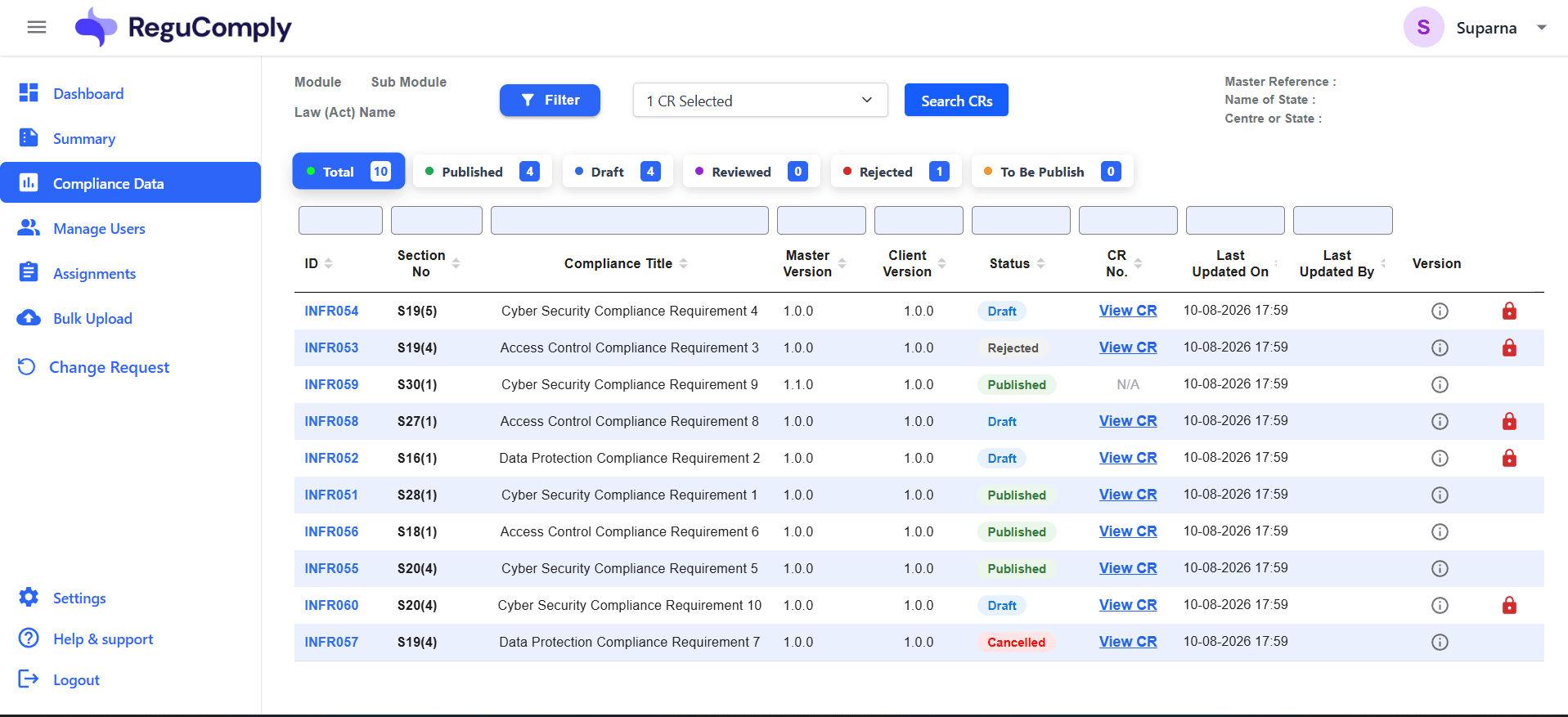
Panel 1: Rule Master & Change Request (CR) Engine
Regulatory curation portal featuring multi-stage Change Request workflows, impact trees, document management, and Monaco-powered visual diffing.
Monaco Diff Editor, TanStack Query v5 cache invalidation, and custom status transition modals.
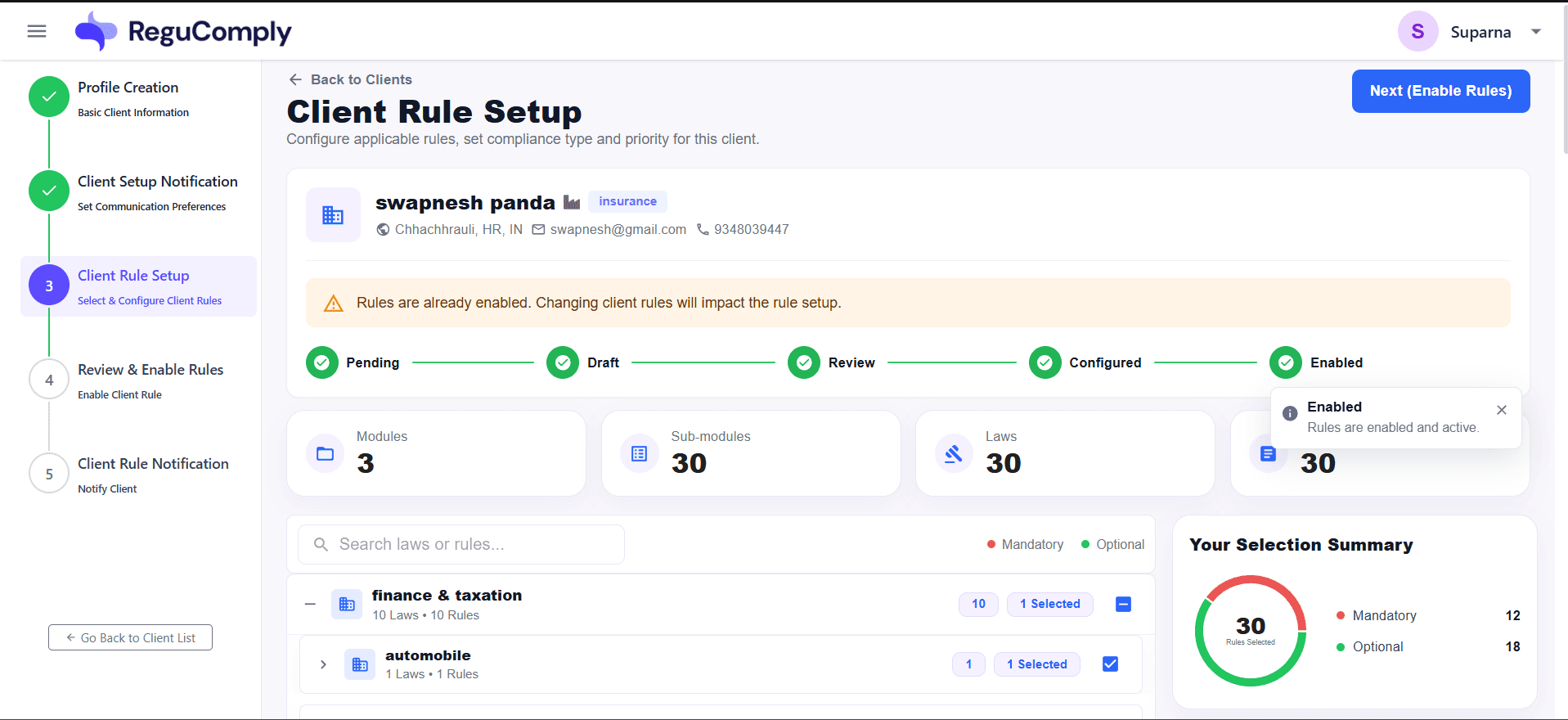
Panel 2: Client Management & Health Telemetry
Multi-tenant administration portal to onboard clients, configure customized regulatory rule mappings, manage rejection audits, and monitor system health.
Modular client overview forms, dynamic rule enablement toggles, and real-time telemetry log monitoring tables.
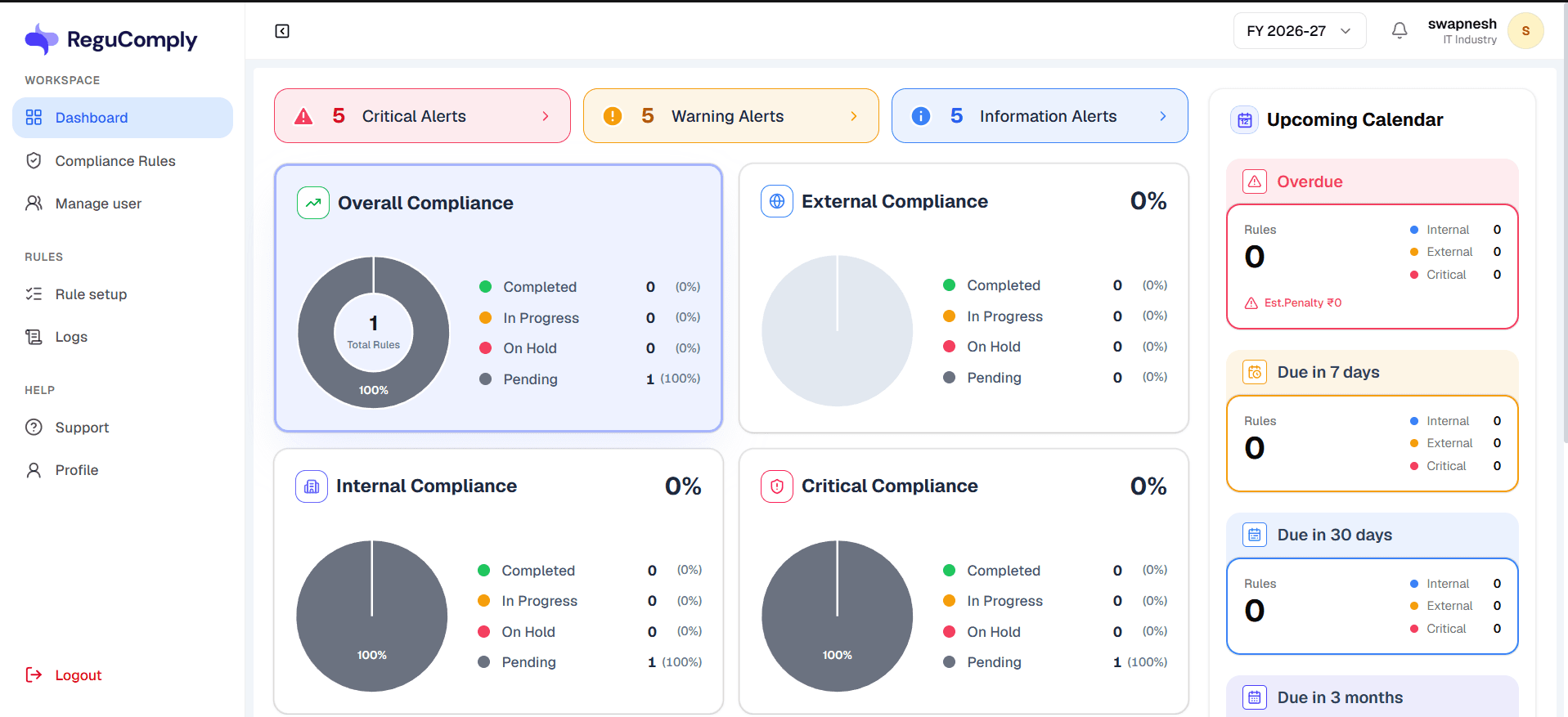
Panel 3: Client Dashboard & Compliance Task Delegation
B2B corporate compliance command center displaying real-time compliance score donuts, upcoming regulatory deadlines, calendar views, and task delegation pipelines.
Radix UI dialogs, Recharts visualizations, Framer Motion transitions, and optimistic task status updates.
Verified Metrics & Telemetry
Coordinated Applications
Rule Master, Client Management, and Client Dashboard built with shared design tokens and consistent API contracts.
Non-Breaking Modernization
Deconstructed massive legacy monoliths with 100% feature preservation across live production flows.
Type Safety Compliance
Clean TypeScript compilation across all three codebases with zero emit errors.
UI State Transitions
Instant cache hits and optimistic updates delivered via TanStack Query v5 and Vite bundling.
Lessons Learned & Architectural Evolution
What Worked Well & Enduring Takeaways
- ✓Incremental deconstruction always beats full rewrites when dealing with live enterprise workflows.
- ✓Remote success depends on clear contracts: documenting UI interfaces early and balancing autonomy with targeted questions.
What I Would Build Differently Today
- ↺If architecting from inception, I would establish a Turborepo monorepo structure with shared UI package workspaces to eliminate token duplication across the three repositories.
- ↺I would implement automated visual regression testing (using Playwright or Chromatic) to accelerate component modernization confidence.